
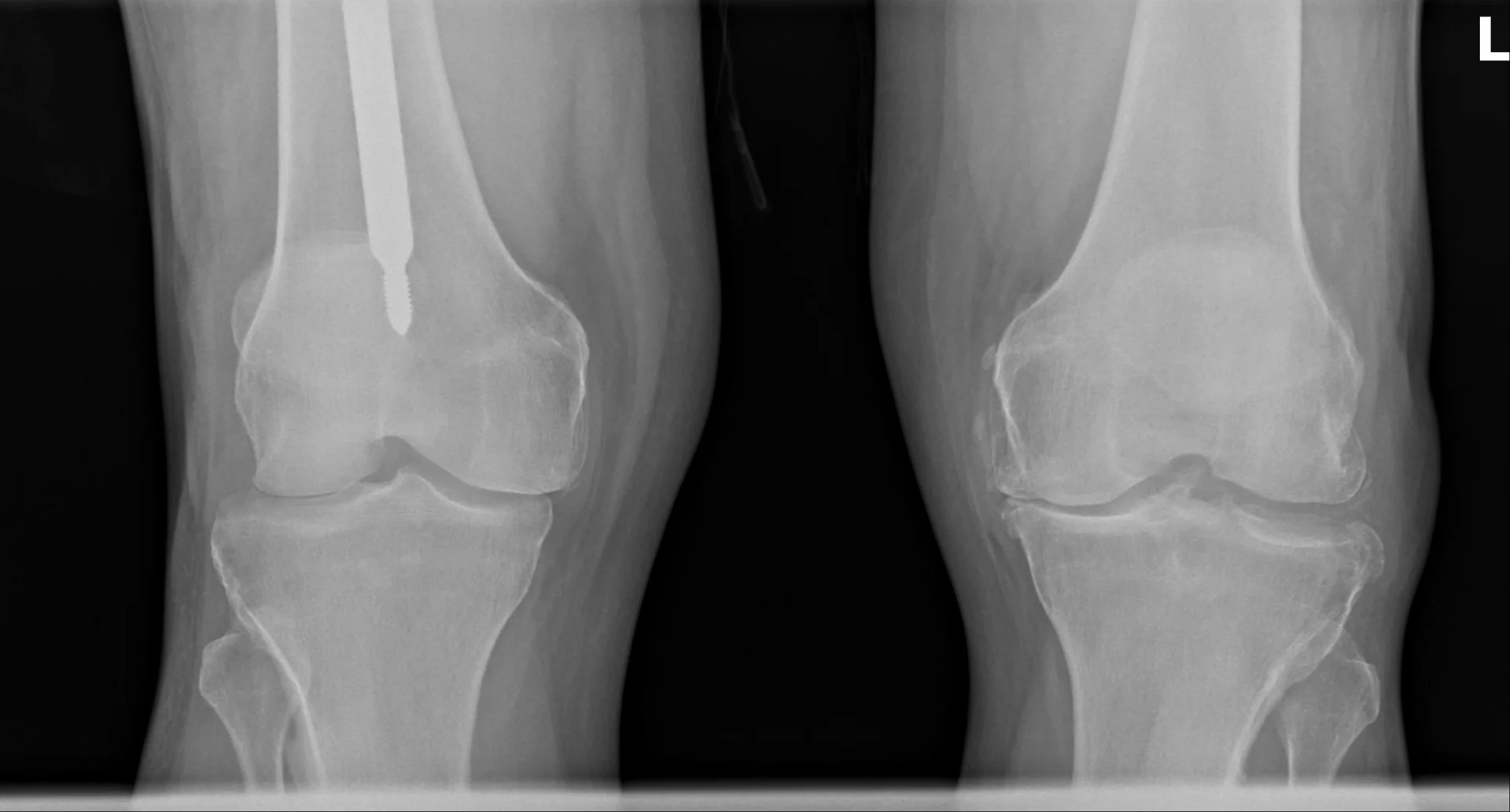
If a doctor has handed you an X-ray and said "bone-on-bone," you probably walked out of that appointment feeling like surgery was inevitable. That phrase carries a lot of weight, and it tends to close the conversation before it has really started. The good news is that imaging findings and how your knee actually functions day to day are two very different things, and for many people over 50 with knee osteoarthritis, there is meaningful ground to cover before an operating room enters the picture.
What "Bone-on-Bone" Actually Means
Knee osteoarthritis is a degenerative condition where the cartilage that cushions the joint gradually wears down. When the cartilage loss is significant enough that the space between the femur and tibia looks narrow or absent on an X-ray, radiologists and physicians describe it as "bone-on-bone." It sounds catastrophic, but the term is really just a description of what shows up on a flat image taken at a single moment in time.
Cartilage does not appear on standard X-rays at all. What you are actually seeing is the absence of the joint space that cartilage used to fill. That is useful information, but it does not tell the whole story.
Why the Image Is Not the Whole Picture
Research has consistently shown a weak correlation between the severity of osteoarthritis on imaging and the amount of pain a person experiences. Some people with severely narrowed joint spaces have very little pain. Others with relatively mild X-ray findings are barely able to walk. Pain is shaped by inflammation, muscle support around the joint, movement patterns, body weight, nervous system sensitivity, and a dozen other factors that an X-ray simply cannot measure.
This matters because it means there are real, addressable contributors to your pain that have nothing to do with the cartilage itself. Treating those contributors can make a significant difference in how you feel and how well you move, even if the underlying structural changes remain.
Conservative Options Worth Knowing About
At WellnessOne, we work with patients who have been told surgery is their only path forward, and many of them find they can reduce pain and get back to daily activities through a combination of non-surgical approaches. Here is a look at what that care can involve.
Knee On-Trac Decompression
Knee On-Trac decompression is a traction-based therapy that gently distracts the knee joint, creating space within the joint capsule. This can reduce compression on sensitive tissues, improve circulation to the area, and help draw synovial fluid back into the joint. Patients often notice a reduction in grinding and stiffness over a course of treatments. It is a comfortable, passive therapy that works well as a foundation for other care.
Laser Therapy
Low-level laser therapy (also called cold laser or photobiomodulation) uses specific wavelengths of light to stimulate cellular repair, reduce inflammation, and support tissue healing. For arthritic joints, it can calm down the inflammatory cycle that drives a lot of the daily aching and swelling people experience. Sessions are painless and typically short.
Electroanalgesia
Electrical stimulation therapies work by interrupting pain signals traveling through the nervous system and by encouraging muscle activation around the knee. Stronger, better-coordinated muscles take load off the joint itself. This kind of support is often underestimated, but the muscles surrounding the knee are doing real mechanical work with every step, and helping them do that job better matters.
Movement and Rehabilitation
Staying mobile is one of the most important things a person with knee osteoarthritis can do, even though pain often makes movement feel like the enemy. Guided movement and targeted exercise help maintain range of motion, build supportive muscle tissue, and prevent the stiffness that comes from guarding a sore joint. We work with patients to find what they can do comfortably and build from there.
Lifestyle Support
Body weight has a direct mechanical effect on knee loading. Carrying an extra ten pounds means tens of thousands of additional pounds of force across the knee joint over the course of a day. Nutritional guidance, anti-inflammatory dietary patterns, and practical advice around activity modification are all part of comprehensive conservative care. These are not substitutes for treatment but they make everything else work better.
You can learn more about the full range of services we offer at wellnessonenebraska.com/services.
What Realistic Goals Look Like
We want to be honest with you: conservative care does not rebuild cartilage. The structural changes in an arthritic knee are not going to reverse on an X-ray. What changes is inflammation, muscle function, joint mechanics, and pain sensitivity, and those changes can be substantial. Many patients go from barely managing daily tasks to walking comfortably, sleeping better, and returning to activities they had written off. That is a meaningful outcome even if the imaging looks the same.
Treatment timelines vary. Some people notice improvement within a few weeks. Others need a longer course of care. Progress tends to be gradual, and maintaining gains requires some ongoing attention to movement and lifestyle. We are upfront about that from the start.
When to See an Orthopedic Surgeon
Conservative care is not right for every situation. There are warning signs that indicate a more urgent orthopedic evaluation is needed, and we take those seriously. Please seek prompt evaluation if you experience any of the following:
- Sudden, severe joint swelling following an injury or fall
- Locking or catching in the knee that prevents full straightening or bending
- Signs of infection such as warmth, redness, and fever
- Instability that causes the knee to give way regularly
- Pain that is rapidly worsening with no identifiable cause
These situations may involve structural damage or other conditions that require surgical or medical intervention. A good conservative care provider will always tell you when they are not the right fit for your situation.
You Have More Options Than One Conversation Suggested
A bone-on-bone diagnosis is not a finish line. For a lot of people, it is actually the beginning of finding care that finally takes the whole picture into account. If you have been sitting with a surgery recommendation and wondering whether there is something else to try first, it is worth having that conversation.
We would be glad to take a look at where you are and what might help. Your first visit is $40 and includes a consultation, exam, and X-rays. Schedule a visit and let us start there.